
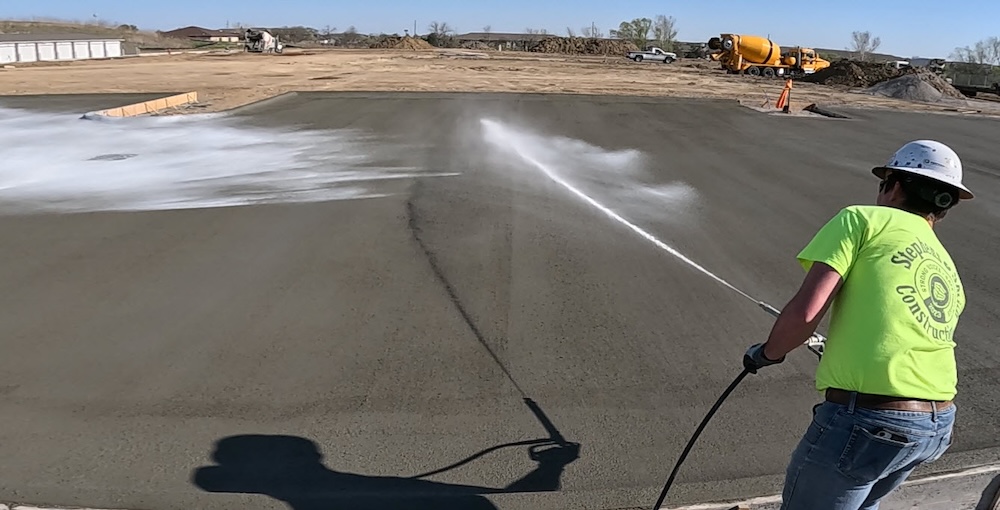
Whether you are installing a new driveway, patio, foundation, or other concrete surface, you want it to last. One of the most important parts of creating durable concrete happens after the concrete has been placed: proper curing.
So, how long does concrete take to cure? Concrete develops strength over time, with 28 days commonly used as an industry benchmark for measuring compressive strength. However, concrete does not suddenly become fully cured on day 28. The curing and strength-development process begins immediately and can continue beyond those first four weeks.
Temperature, moisture, weather conditions, concrete mixture, and the type of project can all influence how concrete develops strength. These factors are especially important in Nebraska and throughout the Midwest, where conditions can change dramatically from one season to the next.
Understanding the concrete curing process can help you protect your investment and know what to expect after your next concrete project.
What Does It Mean for Concrete to Cure?
Concrete curing is more than simply waiting for concrete to dry.
Concrete develops strength through a chemical process called hydration. When cement and water interact, chemical reactions occur that allow the concrete to harden and gain strength. Maintaining appropriate moisture and temperature conditions helps this process continue.
This is why “drying” and “curing” are not interchangeable terms. Allowing fresh concrete to lose moisture too quickly can interfere with proper curing rather than speed it up.
It is also helpful to distinguish between setting, hardening, and curing. Setting is the early stage when fresh concrete begins to become rigid. Hardening and strength development continue after the concrete has set, while proper curing helps provide the conditions necessary for that strength to develop.
At Stephens & Smith Construction, we know that the first 28 days are an important period in the life of newly placed concrete. Proper attention to moisture, temperature, and weather conditions during this time helps concrete develop the strength and durability the project was designed to achieve.
How Long Does Concrete Take to Cure?
There is no single curing timeline that applies to every concrete project. The concrete mixture, temperature, moisture, weather, application, and project specifications can all influence strength development.
However, there are several important stages to understand.
The First 24 to 48 Hours
The first couple of days are an important period for fresh concrete. The concrete is setting and beginning its early strength development.
During this stage, the concrete may need to be protected from conditions that could interfere with proper curing. Depending on the weather, that can include excessive moisture loss, freezing temperatures, high heat, wind, or physical damage to the new surface.
Even if concrete looks hard on the surface, that does not mean it has developed enough strength for every type of use.
The First 7 Days
Concrete continues developing strength rapidly during its first week. Maintaining appropriate curing conditions remains important during this period.
Depending on the project and conditions, contractors may use curing compounds, coverings, water-retaining materials, or other methods to help control moisture loss. Cold-weather projects can require additional measures to maintain appropriate temperatures.
The exact approach depends on the project. There is no single curing method or timeline that should be applied to every concrete installation.
The 28-Day Benchmark
If you have researched concrete curing before, you have probably encountered the number 28 days.
In concrete construction, 28-day compressive strength is commonly used as a standard reference for evaluating whether concrete has achieved its specified strength. This is why you often hear that concrete “takes 28 days to cure.”
However, that description is an oversimplification.
Concrete does not suddenly become 100% cured on the 28th day, nor does strength development necessarily stop at that point. Concrete can continue gaining strength beyond 28 days. The actual rate of strength development depends on factors including the concrete mixture and curing conditions.
Think of 28 days as an important industry benchmark, rather than an expiration date for the curing process.
When Can You Walk or Drive on New Concrete?
One of the most common questions after a new concrete installation is when the surface can be used.
The answer depends partly on what you plan to put on it.
When Can You Walk on New Concrete?
Concrete may be able to withstand light pedestrian traffic before it is ready for heavier loads. However, there is no universal waiting period that is appropriate for every project.
Temperature, concrete mixture, weather, finishing techniques, and other conditions can affect early strength development. Follow the instructions provided by your concrete contractor before walking on a newly placed surface.
When Can You Drive on New Concrete?
A vehicle places significantly more stress on concrete than a person walking across it. That means a driveway may need additional time to develop sufficient strength before it is subjected to vehicle traffic.
The appropriate waiting period depends on the project conditions and concrete being used. Heavy trucks, trailers, recreational vehicles, and construction equipment can create even greater loads.
If Stephens & Smith recently installed your concrete, follow the project-specific instructions provided by our team rather than relying on a general timeline found online.
What Factors Affect Concrete Curing Time?
Concrete curing does not happen in a controlled laboratory environment on most construction projects. Weather and site conditions can have a significant effect on the process.
Temperature
Temperature plays an important role in concrete strength development.
Generally, lower temperatures slow the chemical reactions responsible for strength development. Hot conditions create a different challenge. Higher temperatures can accelerate reactions, while heat, wind, and direct sunlight can also contribute to rapid moisture loss.
This means hotter is not necessarily better when it comes to curing concrete.
Moisture
Water is necessary for cement hydration. Maintaining adequate moisture during curing allows the chemical reactions responsible for strength development to continue.
If fresh concrete loses moisture too quickly, particularly from its surface, it can negatively affect the curing process and the long-term performance of the concrete.
Weather Conditions
Concrete contractors need to consider more than the temperature shown on a weather app.
Humidity, wind, direct sunlight, precipitation, and temperature can all influence concrete placement and curing. Hot, dry, or windy conditions can increase evaporation, while cold conditions can slow strength development and create a risk of freezing if the concrete is not adequately protected.
This is one reason local experience matters when planning concrete work in Nebraska and other parts of the Midwest.
Concrete Mix and Project Type
Not every concrete mixture develops strength at exactly the same rate.
The appropriate concrete mixture and construction specifications can vary depending on whether the project is a driveway, patio, foundation, commercial slab, or another application. Project requirements, materials, reinforcement, weather, and anticipated loads can all influence how the work is planned.
What Is the Best Temperature for Concrete to Cure?
There is no single temperature that guarantees ideal curing for every concrete project. What is clear is that temperature affects how quickly concrete develops strength.
Cold temperatures generally slow strength development, while excessive heat can create challenges related to rapid hydration and moisture loss.
The American Concrete Institute’s cold-weather guidance illustrates how concrete maintained at different temperatures can develop strength at significantly different rates. This is one reason professional contractors pay close attention to weather conditions before, during, and after a pour.
Temperature management becomes particularly important as Midwest temperatures begin to fall.
Can You Pour Concrete in the Winter?
Yes, concrete can be successfully placed during cold weather, but additional planning and protection may be necessary.
Cold-weather concrete work presents several challenges. Low temperatures slow strength development, and newly placed concrete needs to be protected from freezing.
Depending on the conditions and project, cold-weather procedures can include insulating blankets, heated enclosures, adjustments to the concrete mixture, and other methods of maintaining suitable temperatures.
Ground conditions matter as well. Stephens & Smith generally cannot pour concrete directly on frozen ground. Some projects, such as footings, may allow excavation through frozen ground when project conditions and budgets make that approach practical, but the specific situation must be evaluated before work begins.
Cold weather does not automatically make concrete construction impossible. It does make experienced planning and proper protection especially important.
Why Proper Concrete Curing Matters
Proper curing helps concrete develop the strength and durability it was designed to provide.
This can affect several aspects of long-term performance, including:
- Strength development
- Surface durability
- Resistance to environmental exposure
- Overall service life
Proper curing does not mean concrete will never crack.
Concrete can crack for several reasons, including temperature changes, soil movement, heavy loads, shrinkage, and other project or environmental conditions. Proper mix design, reinforcement, joint placement, construction practices, and curing can help manage these risks, but it is not realistic to promise that concrete will remain completely crack-free.
That distinction is particularly important in the Midwest. Nebraska experiences significant seasonal temperature changes, freezing conditions, moisture, heat, and other environmental stresses that concrete surfaces must withstand year after year.
Planning a Concrete Project in Nebraska?
Understanding how long concrete takes to cure is only one part of planning a successful concrete project. Site preparation, concrete selection, placement, finishing, reinforcement, weather conditions, and curing all contribute to the finished product.
Stephens & Smith Construction has been working with concrete since 1971. As an employee-owned concrete construction company, we provide residential and commercial concrete services throughout the Lincoln and Omaha areas.
Our services include concrete flatwork, foundations, decorative concrete, and other specialty concrete applications. Our teams understand the challenges that Nebraska weather can create and plan each project according to its specific requirements.
If you are considering a new driveway, patio, foundation, or other concrete project, contact Stephens & Smith Construction to discuss your project and request an estimate.
Frequently Asked Questions About Concrete Curing
How long does concrete take to fully cure?
Concrete develops strength gradually rather than becoming “fully cured” at one exact moment. The 28-day mark is commonly used as a benchmark for measuring specified compressive strength, but concrete can continue gaining strength beyond 28 days.
How long before you can walk on new concrete?
There is no universal timeframe that applies to every concrete installation. The concrete mixture, temperature, weather, and project conditions can affect early strength development. Follow your contractor’s instructions before walking on newly placed concrete.
How long before you can drive on new concrete?
Concrete needs to develop sufficient strength before supporting vehicle traffic. Because vehicles place much greater loads on concrete than pedestrians, the appropriate waiting period may be longer. Your contractor can provide guidance based on the concrete and conditions specific to your project.
Does concrete cure faster in hot weather?
Higher temperatures can accelerate the chemical reactions occurring in concrete, but that does not necessarily mean hotter conditions produce better results. Excessive heat, wind, and low humidity can increase moisture loss and create additional curing challenges.
Can concrete cure in cold weather?
Yes. Concrete can be successfully placed and cured in cold weather when appropriate procedures are followed. Because cold temperatures slow strength development and fresh concrete needs protection from freezing, cold-weather concrete work can require additional planning and protective measures.
Does concrete keep getting stronger after 28 days?
Yes. Twenty-eight days is a widely used reference point for concrete compressive strength, but concrete can continue gaining strength beyond that point when conditions support continued hydration.